About the book
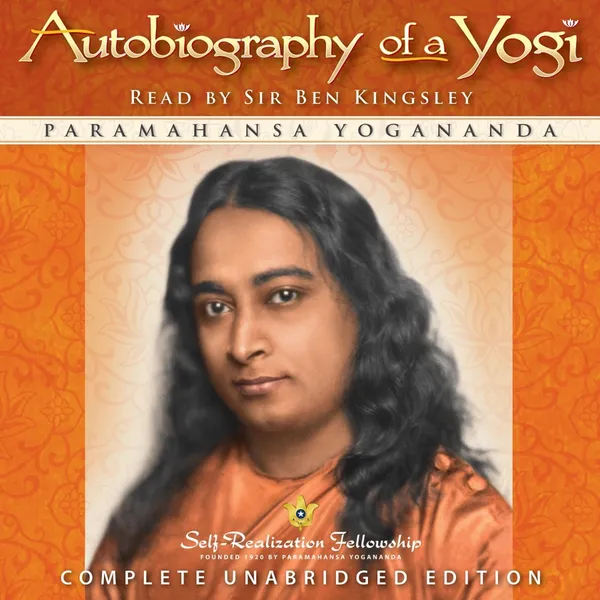
When Autobiography of a Yogi first appeared in 1946, it was acclaimed as a landmark work in its field. The New York Times hailed it as "a rare account". Newsweek pronounced it "fascinating". The San Francisco Chronicle declared, "Yogananda presents a convincing case for yoga, and those who 'came to scoff' may remain 'to pray." Today it is still one of the most widely read and respected books ever published on the wisdom of the East. This audio edition, featuring Academy Award winner Ben Kingsley's masterful narration, contains the complete text of Paramahansa Yogananda's life story, an absorbing account of a singular search for Truth. Yogananda describes his experiences with modern-day saints and illuminated masters of India, and presents a definitive introduction to the whole science and philosophy of Yoga.
Highlights that stuck
My far-reaching memories are not unique. Many yogis are known to have retained their self-consciousness without interruption by the dramatic transition to and from “life” and “death.” If man be solely a body, its loss indeed ends his identity. But if prophets down the millenniums spake with truth, man is essentially a soul, incorporeal and omnipresent.
Father tended first to say “No” to any new proposal. His attitude toward the stranger who so readily had won Mother’s sympathy was an example of his customary caution. An aversion to instant acceptance is really only honoring the principle of “due reflection.” I always found Father reasonable and evenly balanced in his judgments. If I could bolster up my numerous requests with one or two good arguments, he would invariably put within my reach the coveted goal — whether a vacation trip or a new motorcycle.
” Morning found me with a stalwart boil on the indicated spot; the dimensions of Uma’s boil had doubled. With a shriek, my sister rushed to Mother. “Mukunda has become a necromancer!” Gravely, Mother instructed me never to use the power of words for doing harm. I have always remembered her counsel, and followed it.
A mantra or sacred chant words were inscribed on the talisman. The potencies of sound and of vach, the human voice, have nowhere else been so profoundly investigated as in India. The Aum vibration that reverberates throughout the universe (the “Word” or “voice of many waters” of the Bible) has three manifestations or gunas, those of creation, preservation, and destruction (Taittiriya Upanishad I:8). Each time a man utters a word he puts into operation one of the three qualities of Aum. This is the lawful reason behind the injunction of all scriptures that man should speak the truth.
The power of appearing in more than one body is a siddhi (yogic power) mentioned in Patanjali’s Yoga Sutras. The phenomenon of bilocation has been exhibited in the lives of many saints down the ages. In The Story of Therese Neumann (Bruce Pub. Co.), A. P. Schimberg describes several occasions on which this Christian saint has appeared before, and conversed with, distant persons needing her help.
“An indescribable peace blossomed within me at the master’s glance. I was permeated with his fragrance, as though from a lotus of infinity. To be with him, even without exchanging a word for days, was experience which changed my entire being. If any invisible barrier rose in the path of my concentration, I would meditate at the guru’s feet. There the most tenuous states came easily within my grasp. Such perceptions eluded me in the presence of lesser teachers. The master was a living temple of God, whose secret doors were open to all disciples through devotion.
The Tiger Swami made this confession with an impatient gesture, as though at some stupidity. Grimly silent for a long time, he seemed oblivious of our presence. When he took up the dangling thread of his narrative, it was suddenly, with subdued voice.
“An unconscious theological bias was also present, which confounds ignorance with faith. It is often forgotten that He who has surrounded us with this ever-evolving mystery of creation has also implanted in us the desire to question and understand. Through many years of miscomprehension from others, I came to know that the life of a devotee of science is inevitably filled with unending struggle. It is for him to cast his life as an ardent offering — regarding gain and loss, success and failure, as one.
“But high success is not to be obtained without rigid exactitude. Hence the long battery of supersensitive instruments and apparatus of my design, which stand before you today in their cases in the entrance hall. They tell you of the protracted efforts to get behind the deceptive seeming into the reality that remains unseen, of the continuous toil and persistence and resourcefulness called forth to overcome human limitations. All creative scientists know that the true laboratory is the mind, where behind illusions they uncover the laws of truth.
The “hymn called Sama” mentioned in Tagore’s poem is one of the four Vedas. The other three are the Rig, Yajur, and Atharva. The sacred texts expound the nature of Brahma, God the Creator, whose expression in the individual man is termed atma, soul. The verb root of Brahma is brih, “to expand,” conveying the Vedic concept of the divine power of spontaneous growth, of bursting forth into creative activity. The cosmos, like a spider’s web, is said to evolve (vikurute) out of His being. The conscious fusion of atma with Brahma, soul with Spirit, may be said to be the whole import of the Vedas.
77 highlights in my Readwise library; these are the ones I keep coming back to.