Come to think of it, if you have a good idea, or any idea, or a very specific idea; it will work for some people, for some time, in some place.
That's it. That's the whole thing.
Then what's the job of a founder?
Your job as a founder is to find those people. Then overlap them with the time when they care, with the interest they have, and with a place, whether it's on the internet or geographically, any city. And if I might add, at the right price.
People. Time. Place. Price.
All four of them are on a spectrum. None of them is a switch you turn on. You have to test and find out which combination works, and it doesn't matter what business you are building. It's the same.
Where the circles overlap
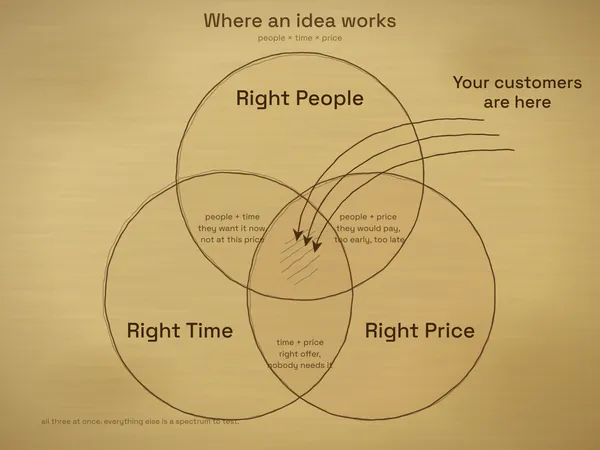
Look at the drawing at the top. Three circles: Right People, Right Time, Right Price. Place is folded into People, because place is simply where your people are, whether that's a city or a subreddit.
Your customers are in the middle, where all three overlap. That part is obvious.
The interesting part is the three places where only two overlap. Every failed launch I have seen, including my own, lived in one of them.
People + Time, without Price. They want it. They want it now. They just won't pay what you're asking. You have the right audience at the right moment and you are pricing them out, or pricing yourself out of a business.
People + Price, without Time. They would pay. They just don't need it yet, or they already solved it last year. This is the "ahead of your time" or "too late" trap. Nothing is wrong with the product. The calendar is wrong.
Time + Price, without People. The offer is right. The moment is right. The price is right. And nobody who needs it has heard of you, because you built it for the wrong room. This one hurts the most, because everything looks correct on paper.
Hence, when something isn't selling, don't ask "is my idea good?" Ask "which circle am I missing?" It is almost always exactly one.
Are you ahead of your time, or late?
People love to say this to founders. "Maybe you are ahead of your time." "Maybe you are too late."
Nobody knows.
Nobody knows unless they need it. And here is the catch; if you already know you need it, it's already too late. Somebody is already building it.
So the idea is to build something that you may not even know you need yet. That's the beauty of it.
It's also why, when you start building, you start with something completely different from what you end up with.
"Nobody ever got ready by waiting. You only get ready by starting."
John C. Maxwell, The 15 Invaluable Laws of Growth
My three pivots
I started with a platform to connect cybersecurity professionals with companies.
Then I pivoted to API security, because that is what I thought my strong suite and strengths were.
Then I watched a few MegaLabs videos on honeypot practices, and over a weekend I built a browser security extension.
The weekend project is the one that stuck. It turned into a completely unexplored market: browser security.
Why browsers? I am glad you asked.
How did we forget the Browser?
It is jaw-dropping to think that we as security professionals, and I specifically as a security professional, completely forgot how big of an attack surface your browser is.
And how much your browser knows about you:
- Your history
- The sites you visit
- The things you do on those sites
- The apps you open
- The time you open them
- The time they stay open, maybe unfocused
- How many tabs you have open right now
Not to talk about all the extensions and the permissions they carry, and the harm those permissions can do. Not to talk about the flags you can enable. Developer tools, network capture, and so on; all the tools available to you inside a browser, for free.
It is just mind-boggling.
We were worrying about phishing pages and malicious websites and people not going through their security training. And we completely forgot that the browser is the window through which you experience the internet.
What is the most used software?
If I were to ask you, "What's the most used software at work?" or "What's the most used software at home on your OS?"
It would be your browser. Regardless of which browser, regardless of which version. It has to be a browser.
Ask any non-technical person, "What is the internet?" The browser is what they will describe to you.
Or try this as a thought exercise.
Take the browser away. There is no concept of a browser. The internet is still there. No browser.
How would you experience it? Would you even be able to experience the internet as we know it today?
I cannot stop thinking about that question. Can you?
Conclusion
Every idea works for someone, somewhere, for some time, at some price. Your job is to find the overlap.
Nobody can tell you if you are early or late. Hence, stop asking and start building.
What you start building is not what you will end up building, and that's okay. That's the search working.
And sometimes the biggest market is hiding inside the software you open first thing every morning.