About the book
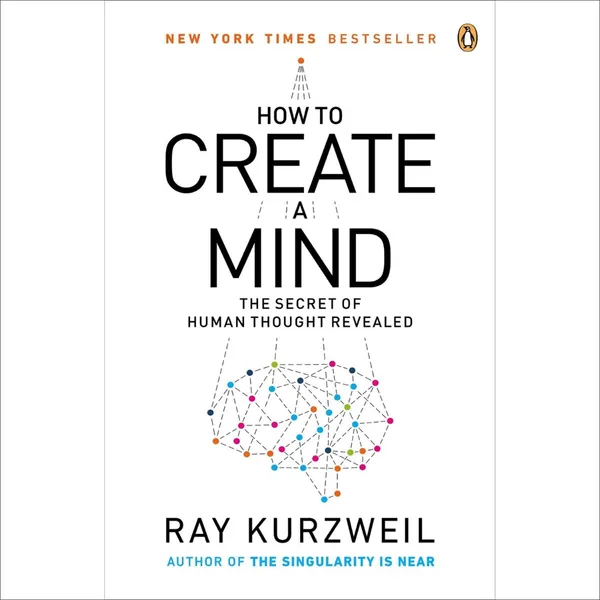
NEW YORK TIMES BESTSELLER • The bold futurist and renowned author of The Singularity Is Near explores the limitless potential of reverse-engineering the human brain. “This book is a Rosetta Stone for the mystery of human thought.”—Martine Rothblatt, chairman and CEO, United Therapeutics, and creator of Sirius XM Satellite Radio “Kurzweil’s vision of our super-enhanced future is completely sane and calmly reasoned, and his book should nicely smooth the path for the earth’s robot overlords, who, it turns out, will be us.” —The New York Times In How to Create a Mind, Ray Kurzweil presents a provocative exploration of the most important project in human-machine civilization: reverse-engineering the brain to understand precisely how it works and using that knowledge to create even more intelligent machines. Kurzweil discusses how the brain functions, how the mind emerges, brain-computer interfaces, and the implications of vastly increasing the powers of our intelligence to address the world’s problems. He also thoughtfully examines emotional and moral intelligence and the origins of consciousness and envisions the radical possibilities of our merging with the intelligent technology we are creating. Drawing on years of advanced research and cutting-edge inventions in artificial intelligence, How to Create a Mind is an incredible synthesis of neuroscience and technology and provides a road map for the future of human progress.
Highlights that stuck
How the universe got to be this way is itself an interesting story. The standard model of physics has dozens of constants that need to be precisely what they are, or atoms would not have been possible, and there would have been no stars, no planets, no brains, and no books on brains. That the laws of physics are so precisely tuned to have allowed the evolution of information appears to be incredibly unlikely.
In this book I present a thesis I call the pattern recognition theory of mind (PRTM), which, I argue, describes the basic algorithm of the neocortex (the region of the brain responsible for perception, memory, and critical thinking). In the chapters ahead I describe how recent neuroscience research, as well as our own thought experiments, leads to the inescapable conclusion that this method is used consistently across the neocortex. The implication of the PRTM combined with the LOAR is that we will be able to engineer these principles to vastly extend the powers of our own intelligence.
Millions of people witnessed the IBM computer named Watson play the natural-language game of Jeopardy! and obtain a higher score than the best two human players in the world combined. It should be noted that not only did Watson read and “understand” the subtle language in the Jeopardy! query (which includes such phenomena as puns and metaphors), but it obtained the knowledge it needed to come up with a response from understanding hundreds of millions of pages of natural-language documents including Wikipedia and other encyclopedias on its own. It needed to master virtually every area of human intellectual endeavor, including history, science, literature, the arts, culture, and more.
Let’s think about what it means to be complex. We might ask, is a forest complex? The answer depends on the perspective you choose to take. You could note that there are many thousands of trees in the forest and that each one is different. You could then go on to note that each tree has thousands of branches and that each branch is completely different. Then you could proceed to describe the convoluted vagaries of a single branch. Your conclusion might be that the forest has a complexity beyond our wildest imagination.
But such an approach would literally be a failure to see the forest for the trees. Certainly there is a great deal of fractal variation among trees and branches, but to correctly understand the principles of a forest you would do better to start by identifying the distinct patterns of redundancy with stochastic (that is, random) variation that are found there. It would be fair to say that the concept of a forest is simpler than the concept of a tree.
One person who was carefully watching the response of the scientific community to Lyell’s radical thesis was English naturalist Charles Darwin (1809–1882). Consider the situation in biology around 1850. The field was endlessly complex, faced with countless species of animals and plants, any one of which presented great intricacy. If anything, most scientists resisted any attempt to provide a unifying theory of nature’s dazzling variation. This diversity served as a testament to the glory of God’s creation, not to mention to the intelligence of the scientists who were capable of mastering it.
The answer became evident to the German boy, whose name, incidentally, was Albert Einstein (1879–1955), by the time he turned twenty-six. Obviously—to young Master Einstein—time itself must have slowed down for him. He explains his reasoning in a paper published in 1905. 7 If observers on Earth were to look at the young man’s watch they would see it ticking ten times slower. Indeed, when he got back to Earth, his watch would show that only 10 percent as much time had passed (ignoring, for the moment, acceleration and deceleration). From his perspective, however, his watch was ticking normally and the light beam next to him was traveling at the speed of light.
Conversely, this history also demonstrates the limitations of human thinking. Einstein was able to ride his light beam without falling off (albeit he concluded that it was impossible to actually ride a light beam), but how many thousands of other observers and thinkers were completely unable to think through these remarkably uncomplicated exercises? One common failure is the difficulty that most people have in discarding and transcending the ideas and perspectives of their peers. There are other inadequacies as well, which we will discuss in more detail after we have examined how the neocortex works.
In order to assess the extent to which my own brain is similar to the computer programs I was familiar with, I began to think about what my brain must be doing as it processed information. I have continued this investigation for fifty years. What I will describe below about our current understanding of how the brain works will sound very different from the standard concept of a computer. Fundamentally, however, the brain does store and process information, and because of the universality of computation—a concept to which I will also return—there is more of a parallel between brains and computers than may be apparent.
Unless you have studied the alphabet in this order, you are likely to find it impossible to do. On occasion someone who has spent a significant amount of time in an elementary school classroom where the alphabet is displayed will be able to call up his visual memory and then read it backward from that. Even this is difficult, though, because we do not actually remember whole images. Reciting the alphabet backward should be a simple task, as it involves exactly the same information as reciting it forward, yet we are generally unable to do it.
70 highlights in my Readwise library; these are the ones I keep coming back to.