About the book
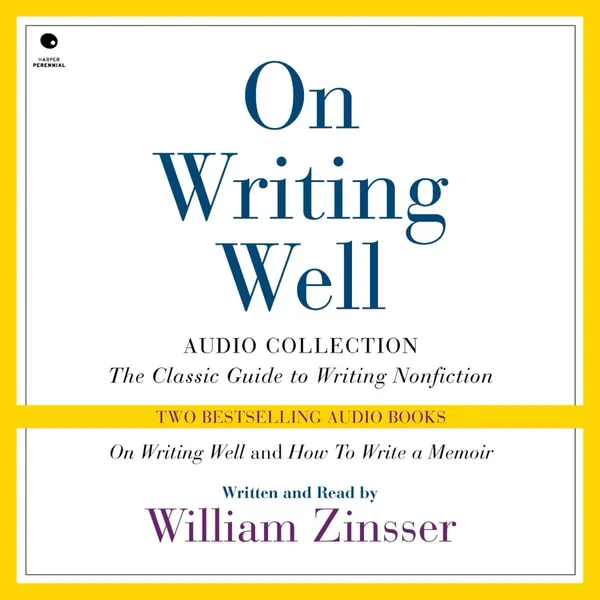
This expanded audio collection presents William Zinsser's On Writing Well, the classic teaching book that has sold more than 1 million copies, together with a new 90-minute section that tells you how to write a memoir.
Highlights that stuck
One of the pictures hanging in my office in mid-Manhattan is a photograph of the writer E. B. White. It was taken by Jill Krementz when White was 77 years old, at his home in North Brooklin, Maine. A white-haired man is sitting on a plain wooden bench at a plain wooden table—three boards nailed to four legs—in a small boathouse. The window is open to a view across the water. White is typing on a manual typewriter, and the only other objects are an ashtray and a nail keg. The keg, I don’t have to be told, is his wastebasket.
Ultimately the product that any writer has to sell is not the subject being written about, but who he or she is. I often find myself reading with interest about a topic I never thought would interest me—some scientific quest, perhaps. What holds me is the enthusiasm of the writer for his field. How was he drawn into it? What emotional baggage did he bring along? How did it change his life? It’s not necessary to want to spend a year alone at Walden Pond to become involved with a writer who did.
This is the personal transaction that’s at the heart of good nonfiction writing. Out of it come two of the most important qualities that this book will go in search of: humanity and warmth. Good writing has an aliveness that keeps the reader reading from one paragraph to the next, and it’s not a question of gimmicks to “personalize” the author. It’s a question of using the English language in a way that will achieve the greatest clarity and strength.
Clutter is the disease of American writing. We are a society strangling in unnecessary words, circular constructions, pompous frills and meaningless jargon.
But the secret of good writing is to strip every sentence to its cleanest components. Every word that serves no function, every long word that could be a short word, every adverb that carries the same meaning that’s already in the verb, every passive construction that leaves the reader unsure of who is doing what—these are the thousand and one adulterants that weaken the strength of a sentence. And they usually occur in proportion to education and rank.
How can the rest of us achieve such enviable freedom from clutter? The answer is to clear our heads of clutter. Clear thinking becomes clear writing; one can’t exist without the other. It’s impossible for a muddy thinker to write good English. He may get away with it for a paragraph or two, but soon the reader will be lost, and there’s no sin so grave, for the reader will not easily be lured back.
Writers must therefore constantly ask: what am I trying to say? Surprisingly often they don’t know. Then they must look at what they have written and ask: have I said it? Is it clear to someone encountering the subject for the first time? If it’s not, some fuzz has worked its way into the machinery. The clear writer is someone clearheaded enough to see this stuff for what it is: fuzz.
The point is that you have to strip your writing down before you can build it back up. You must know what the essential tools are and what job they were designed to do. Extending the metaphor of carpentry, it’s first necessary to be able to saw wood neatly and to drive nails. Later you can bevel the edges or add elegant finials, if that’s your taste. But you can never forget that you are practicing a craft that’s based on certain principles. If the nails are weak, your house will collapse. If your verbs are weak and your syntax is rickety, your sentences will fall apart.
This is the problem of writers who set out deliberately to garnish their prose. You lose whatever it is that makes you unique. The reader will notice if you are putting on airs. Readers want the person who is talking to them to sound genuine. Therefore a fundamental rule is: be yourself.
That’s a firm conviction? Leaders who bob and weave like aging boxers don’t inspire confidence—or deserve it. The same thing is true of writers. Sell yourself, and your subject will exert its own appeal. Believe in your own identity and your own opinions. Writing is an act of ego, and you might as well admit it. Use its energy to keep yourself going.
56 highlights in my Readwise library; these are the ones I keep coming back to.