About the book
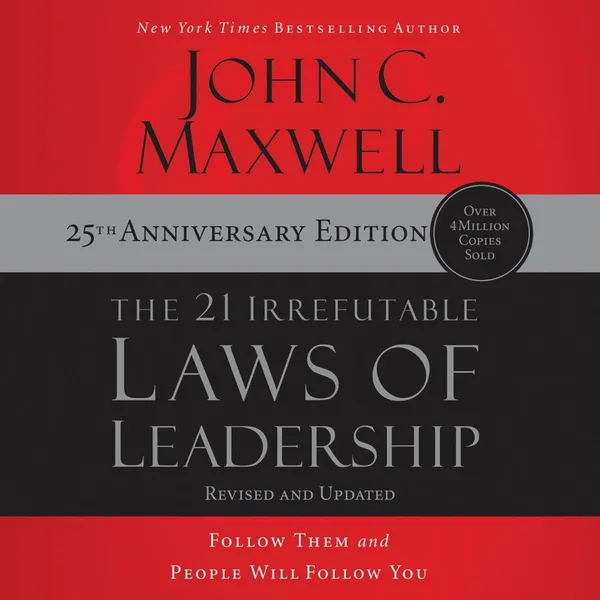
For the first time ever, hear the bestselling leadership book of all time, read in its entirety by John Maxwell himself!
HarperCollins and John C. Maxwell are celebrating the milestone anniversary of Maxwell’s New York Times bestselling book, The 21 Irrefutable Laws of Leadership, with the publication of a revised and updated 25th anniversary edition. This will be the first time Maxwell has read the full unabridged audiobook. Included only on this audio edition are insights from Maxwell on each law and how they have impacted his life as a leader and mentor. There will also be stories from some of today’s most impactful leaders, like entrepreneur and cofounder of IT Cosmetics Jamie Kern Lima, Maxwell Leadership CEO Mark Cole, and author and marketing expert Jeff Henderson, on how they have applied these laws to their own success journeys.
Maxwell has gone through every word of this book and updated it for the next generation of leaders. He has added new insights to these timeless laws and included lessons learned since he originally wrote the book 25 years ago. And he has included some exciting new stories that apply the laws to today’s business world.
What Maxwell didn’t change are the powerful leadership truths that have been helping people become better leaders for the last quarter century. This is still the best book on leadership people can buy, whether they want to learn leadership on their own, develop as leaders in a group, or teach leadership to others as a mentor.
Readers new to Maxwell, as well as lifelong fans, will enjoy this new edition of the leadership book that has sold millions of copies in the United States and around the world.
Accompanying visuals and an assessment are included in the audiobook companion PDF download.
Highlights that stuck
When John Maxwell asked me to write the foreword for this 10th anniversary edition of The 21 Irrefutable Laws of Leadership, I was honored and intrigued. During the past two decades, John and I have traveled on parallel paths in our speaking and writing. We have both been called “leadership experts” over the years. We know and respect each other’s work. But in spite of the similarities between our messages, we have rarely spoken to the same audience.
I believe that success is within the reach of just about everyone. But I also believe that personal success without leadership ability brings only limited effectiveness. Without leadership ability, a person’s impact is only a fraction of what it could be with good leadership. The higher you want to climb, the more you need leadership. The greater the impact you want to make, the greater your influence needs to be. Whatever you will accomplish is restricted by your ability to lead others.
At that time if just about any other person in the world had made those statements, people’s reactions would have been openly hostile. They would have booed, jeered, or stormed out. But the speaker was Mother Teresa. She was probably the most respected person on the planet at that time. So everyone listened to what she had to say, even though many of them violently disagreed with it. In fact, every time that Mother Teresa spoke, people listened. Why? She was a real leader, and when the real leader speaks, people listen. Leadership is influence—nothing more, nothing less.
The true measure of leadership is influence—nothing more, nothing less. Margaret Thatcher, the former British prime minister, observed, “Being in power is like being a lady. If you have to tell people you are, you aren’t.” If you watch the dynamics that occur between people in just about every aspect of life, you will see some people leading and others following, and you will notice that position and title often have little to do with who is really in charge.
But in voluntary organizations the thing that works is leadership in its purest form: influence. Psychologist Harry A. Overstreet observed, “The very essence of all power to influence lies in getting the other person to participate.” Followers in voluntary organizations cannot be forced to get on board. If the leader has no influence with them, then they won’t follow.
One of my favorite stories that illustrates the Law of Influence concerns Abraham Lincoln. In 1832, decades before he became president, young Lincoln gathered together a group of men to fight in the Black Hawk War. In those days, the person who put together a volunteer company for the militia often became its leader and assumed a commanding rank. In this instance, Lincoln was given the rank of captain. But Lincoln had a problem. He knew nothing about soldiering. He had no prior military experience, and he knew nothing about tactics. He had trouble remembering the simplest military procedures.
I love the leadership proverb that says, “He who thinks he leads, but has no followers, is only taking a walk.” If you can’t influence people, then they will not follow you. And if people won’t follow, you are not a leader. That’s the Law of Influence. No matter what anybody else may tell you, remember that leadership is influence—nothing more, nothing less.
Anne Scheiber was 101 years old when she died in January 1995. For years she had lived in a tiny, run-down, rent-controlled studio apartment in Manhattan. The paint on the walls was peeling, and the old bookcases that lined the walls were covered in dust. Rent was four hundred dollars a month.
Roosevelt, a boxer himself, was the ultimate man of action. Not only was he an effective leader, but he was one of the most flamboyant of all U.S. presidents. British historian Hugh Brogan described him as “the ablest man to sit in the White House since Lincoln; the most vigorous since Jackson; the most bookish since John Quincy Adams.”
Followers need leaders able to effectively navigate for them. When they’re facing life-and-death situations, the necessity is painfully obvious. But even when consequences aren’t as serious, the need is also great. The truth is that nearly anyone can steer the ship, but it takes a leader to chart the course. That is the Law of Navigation.
41 highlights in my Readwise library; these are the ones I keep coming back to.