About the book
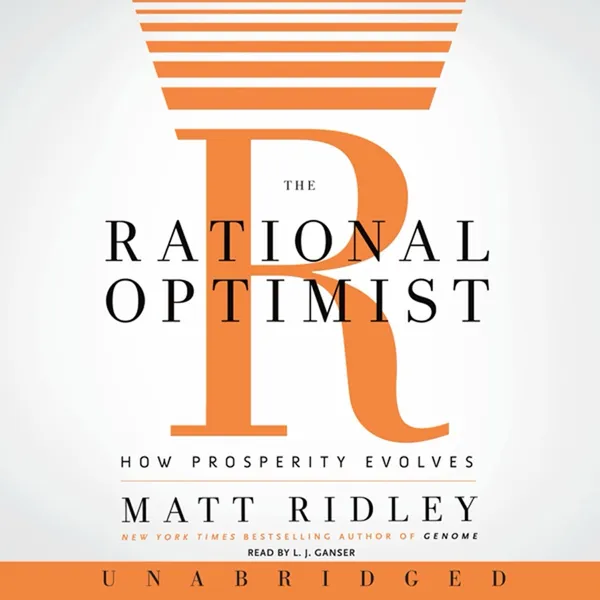
“A delightful and fascinating book filled with insight and wit, which will make you think twice and cheer up.” — Steven Pinker In a bold and provocative interpretation of economic history, Matt Ridley, the New York Times -bestselling author of Genome and The Red Queen , makes the case for an economics of hope, arguing that the benefits of commerce, technology, innovation, and change—what Ridley calls cultural evolution—will inevitably increase human prosperity. Fans of the works of Jared Diamond ( Guns, Germs, and Steel ), Niall Ferguson ( The Ascent of Money ), and Thomas Friedman ( The World Is Flat ) will find much to ponder and enjoy in The Rational Optimist. For two hundred years the pessimists have dominated public discourse, insisting that things will soon be getting much worse. But in fact, life is getting better—and at an accelerating rate. Food availability, income, and life span are up; disease, child mortality, and violence are down all across the globe. Africa is following Asia out of poverty; the Internet, the mobile phone, and container shipping are enriching people's lives as never before. An astute, refreshing, and revelatory work that covers the entire sweep of human history—from the Stone Age to the Internet— The Rational Optimist will change your way of thinking about the world for the better.
Highlights that stuck
Look again at the hand axe and the mouse. They are both ‘man-made’, but one was made by a single person, the other by hundreds of people, maybe even millions. That is what I mean by collective intelligence. No single person knows how to make a computer mouse. The person who assembled it in the factory did not know how to drill the oil well from which the plastic came, or vice versa. At some point, human intelligence became collective and cumulative in a way that happened to no other animal.
Yes, but why? Why us and not killer whales? To say that people have cultural evolution is neither very original nor very helpful. Imitation and learning are not themselves enough, however richly and ingeniously they are practised, to explain why human beings began changing in this unique way. Something else is necessary; something that human beings have and killer whales do not. The answer, I believe, is that at some point in human history, ideas began to meet and mate, to have sex with each other.
Some will say that I am merely restating what Adam Smith said in 1776. But much has happened since Adam Smith to change, challenge, adjust and amplify his insight. He did not realise, for instance, that he was living through the early stages of an industrial revolution. I cannot hope to match Smith’s genius as an individual, but I have one great advantage over him – I can read his book. Smith’s own insight has mated with others since his day.
Well all right, says the pessimist, but at what cost? The environment is surely deteriorating. In somewhere like Beijing, maybe. But in many other places, no. In Europe and America rivers, lakes, seas and the air are getting cleaner all the time. The Thames has less sewage and more fish. Lake Erie’s water snakes, on the brink of extinction in the 1960s, are now abundant. Bald eagles have boomed. Pasadena has few smogs. Swedish birds’ eggs have 75 per cent fewer pollutants in them than in the 1960s. American carbon monoxide emissions from transport are down 75 per cent in twenty-five years. Today, a car emits less pollution traveling at full speed than a parked car did in 1970 from leaks.
As long as new ideas can breed in this way, then human economic progress can continue. It may be only a year or two till world growth resumes after the current crisis, or it may for some countries be a lost decade. It may even be that parts of the world will be convulsed by a descent into autarky, authoritarianism and violence, as happened in the 1930s, and that a depression will cause a great war. But so long as somewhere somebody is incentivised to invent ways of serving others’ needs better, then the rational optimist must conclude that the betterment of human lives will eventually resume.
Barter is a lot more portentous than reciprocity. After all, delousing aside, how many activities are there in life where it pays to do the same thing to each other in turn? ‘If I sew you a hide tunic today, you can sew me one tomorrow’ brings limited rewards and diminishing returns. ‘If I make the clothes, you catch the food’ brings increasing returns. Indeed, it has the beautiful property that it does not even need to be fair. For barter to work, two individuals do not need to offer things of equal value. Trade is often unequal, but still benefits both sides. This is a point that nearly everybody seems to miss.
The archaeologist who first described the Tasmanian regress, Rhys Jones, called it a case of the ‘slow strangulation of the mind’, which perhaps understandably enraged some of his academic colleagues. There was nothing wrong with individual Tasmanian brains; there was something wrong with their collective brains. Isolation – self-sufficiency – caused the shrivelling of their technology. Earlier I wrote that division of labour was made possible by technology. But it is more interesting than that. Technology was made possible by division of labour: market exchange calls forth innovation.
The lesson is stark. Self-sufficiency was dead tens of thousand years ago. Even the relatively simple lifestyle of a hunter-gatherer cannot exist without a large population exchanging ideas and skills. The importance of this notion cannot be emphasised too strongly. The success of human beings depends crucially, but precariously, on numbers and connections. A few hundred people cannot sustain a sophisticated technology: trade is a vital part of the story.
The lesson of this study is that, on the whole, having to deal with strangers teaches you to be polite to them, and that in order for such generosity to emerge, costly punishment of selfishness may be necessary. Rejecting the offer is costly for the second player, but he reckons it is worth it to teach the first player a lesson. The argument is not that exchange teaches people to be kind; it is that exchange teaches people to recognise their enlightened self-interest lies in seeking cooperation. Here, then, lies a clue to the unique human attribute of being able to deal with strangers, to extend the division of labour to include even your enemies.
Companies have a far shorter half-life than government agencies. Half of the biggest American companies of 1980 have now disappeared by take-over or bankruptcy; half of today’s biggest companies did not even exist in 1980. The same is not true of government monopolies: the Internal Revenue Service and the National Health Service will not die, however much incompetence they might display. Yet most anti-corporate activists have faith in the good will of the leviathans that can force you to do business with them, but are suspicious of the behemoths that have to beg for your business. I find that odd.
51 highlights in my Readwise library; these are the ones I keep coming back to.