About the book
An Avid Reader Press book. Simon & Schuster has a great book for every reader.
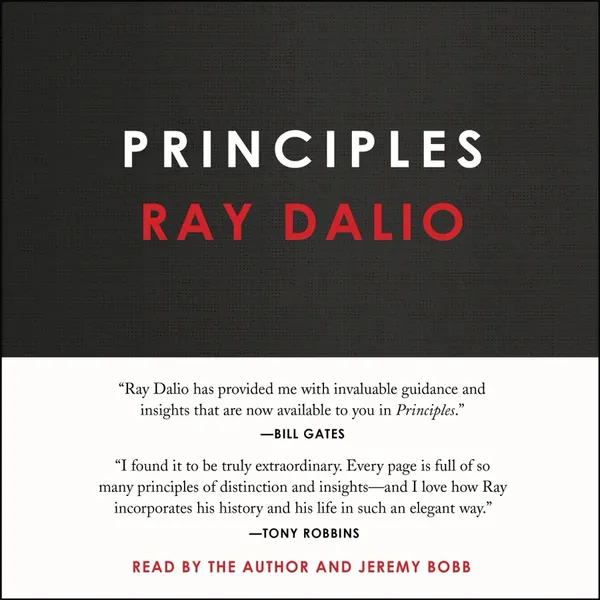
In 1975, Ray Dalio founded an investment firm, Bridgewater Associates, out of his two-bedroom apartment in New York City. Forty years later, Bridgewater has made more money for its clients than any other hedge fund in history and grown into the fifth most important private company in the United States, according to Fortune magazine. Dalio himself has been named to Time magazine’s list of the 100 most influential people in the world. Along the way, Dalio discovered a set of unique principles that have led to Bridgewater’s exceptionally effective culture, which he describes as “an idea meritocracy that strives to achieve meaningful work and meaningful relationships through radical transparency.” It is these principles, and not anything special about Dalio—who grew up an ordinary kid in a middle-class Long Island neighborhood—that he believes are the reason behind his success.
In Principles, Dalio shares what he’s learned over the course of his remarkable career. He argues that life, management, economics, and investing can all be systemized into rules and understood like machines. The book’s hundreds of practical lessons, which are built around his cornerstones of “radical truth” and “radical transparency,” include Dalio laying out the most effective ways for individuals and organizations to make decisions, approach challenges, and build strong teams. He also describes the innovative tools the firm uses to bring an idea meritocracy to life, such as creating “baseball cards” for all employees that distill their strengths and weaknesses, and employing computerized decision-making systems to make believability-weighted decisions. While the book brims with novel ideas for organizations and institutions, Principles also offers a clear, straightforward approach to decision-making that Dalio believes anyone can apply, no matter what they’re seeking to achieve.
Here, from a man who has been called both “the Steve Jobs of investing” and “the philosopher king of the financial universe” (CIO magazine), is a rare opportunity to gain proven advice unlike anything you’ll find in the conventional business press.
Highlights that stuck
Learning to meditate helped too. When the Beatles visited India in 1968 to study Transcendental Meditation at the ashram of Maharishi Mahesh Yogi, I was curious to learn it, so I did. I loved it. Meditation has benefited me hugely throughout my life because it produces a calm open-mindedness that allows me to think more clearly and creatively.
1. Seek out the smartest people who disagreed with me so I could try to understand their reasoning. 2. Know when not to have an opinion. 3. Develop, test, and systemize timeless and universal principles. 4. Balance risks in ways that keep the big upside while reducing the downside.
After about a year of this, I could see that running both Bridgewater and Bridgewater China Partners wasn’t going to be possible, so I closed its doors. Nobody made or lost any money, because I hadn’t been comfortable enough with what I was seeing to make any investments. I’m sure that if I had devoted all my time to it, we would have had great success, but then Bridgewater would not be what it is today. Despite passing up this great opportunity, I don’t regret my choice. I learned that if you work hard and creatively, you can have just about anything you want, but not everything you want. Maturity is the ability to reject good alternatives in order to pursue even better ones.
I believe that all organizations basically have two types of people: those who work to be part of a mission, and those who work for a paycheck. I wanted to surround myself with people who needed what I needed, which was to make sense of things for myself. I spoke frankly, and I expected those around me to speak frankly. I fought for what I thought was best, and I wanted them to do so as well. When I thought someone did something stupid, I said so and I expected them to tell me when I did something stupid. Each of us would be better for it. To me, that was what strong and productive relationships looked like. Operating any other way would be unproductive and unethical.
To me, the greatest success you can have as the person in charge is to orchestrate others to do things well without you. A step below that is doing things well yourself, and worst of all is doing things poorly yourself. As I reflected on my position, I could see that despite all of my and Bridgewater’s amazing achievements, I had not achieved this highest level of success. In fact, I was still struggling to achieve the second-highest level (doing things well myself), even though Bridgewater was extremely successful.
I gave Wang a copy of Joseph Campbell’s great book The Hero with a Thousand Faces, because he is a classic hero and I thought it might help him. I also gave him The Lessons of History, a 104-page distillation of the major forces through history by Will and Ariel Durant, and River Out of Eden by the insightful Richard Dawkins, which explains how evolution works. He gave me Georgi Plekhanov’s classic On the Role of the Individual in History. All these books showed how the same things happened over and over again throughout history.
a. Don’t get hung up on your views of how things “should” be because you will miss out on learning how they really are. It’s important not to let our biases stand in the way of our objectivity. To get good results, we need to be analytical rather than emotional.
d. Realize that you are simultaneously everything and nothing—and decide what you want to be. It is a great paradox that individually we are simultaneously everything and nothing. Through our own eyes, we are everything—e.g., when we die, the whole world disappears. So to most people (and to other species) dying is the worst thing possible, and it is of paramount importance that we have the best life possible. However, when we look down on ourselves through the eyes of nature we are of absolutely no significance. It is a reality that each one of us is only one of about seven billion of our species alive today and that our species is only one of about ten million species on our planet.
e. Successful people are those who can go above themselves to see things objectively and manage those things to shape change. They can take in the perspectives of others instead of being trapped in their own heads with their own biases. They are able to look objectively at what they are like—their strengths and weaknesses—and what others are like to put the right people in the right roles to achieve their goals. Once you understand how to do this you’ll see that there’s virtually nothing you can’t accomplish. You will just have to learn how to face your realities and use the full range of resources at your disposal.
You will need to do all five steps well to be successful and you must do them one at a time and in order. For example, when setting goals, just set goals. Don’t think about how you will achieve them or what you will do if something goes wrong. When you are diagnosing problems, don’t think about how you will solve them—just diagnose them. Blurring the steps leads to suboptimal outcomes because it interferes with uncovering the true problems. The process is iterative: Doing each step thoroughly will provide you with the information you need to move on to the next step and do it well.
51 highlights in my Readwise library; these are the ones I keep coming back to.